Our research

The model is proven. We are expanding the evidence base.

Case conferencing has been tested in randomised trials, systematic reviews and cost analyses — and it works. Our research programme takes that proven model across common primary care disease contexts: mental health, diabetes, rural care, post-surgical recovery, and paediatrics — in partnership with leading research institutions, to improve patient outcomes and help shape national healthcare policy.

The evidence base

The model already has a track record

Multidisciplinary case conferencing is not a new idea, and it is not an untested one. Where it has been studied properly — in palliative care, in dementia, in residential aged care — it has stood up to randomised trials, systematic reviews and health-economic analysis.

The same model is now used every week for diabetes, cardiac disease, chronic pain, mental health and complex paediatrics, and for patients hundreds of kilometres from their nearest specialist — at a scale, and across a range of conditions, the earlier trials could not reach.

Palliative care

Case conferencing between GPs and specialist palliative care services has been tested in randomised trials, including a multi-site Australian RCT of quality-of-life outcomes.

Dementia and aged care

A cluster randomised trial of facilitated family case conferencing in advanced dementia, alongside two systematic reviews and an integrative review of case conferencing in residential aged care.

Cost and hospital use

Australian work has found end-of-life case conference planning between primary and secondary care can reduce the cost of hospitalisations, and US primary-care case conferences have been linked to reduced health care utilisation.

Published & presented

Where we've taken the work

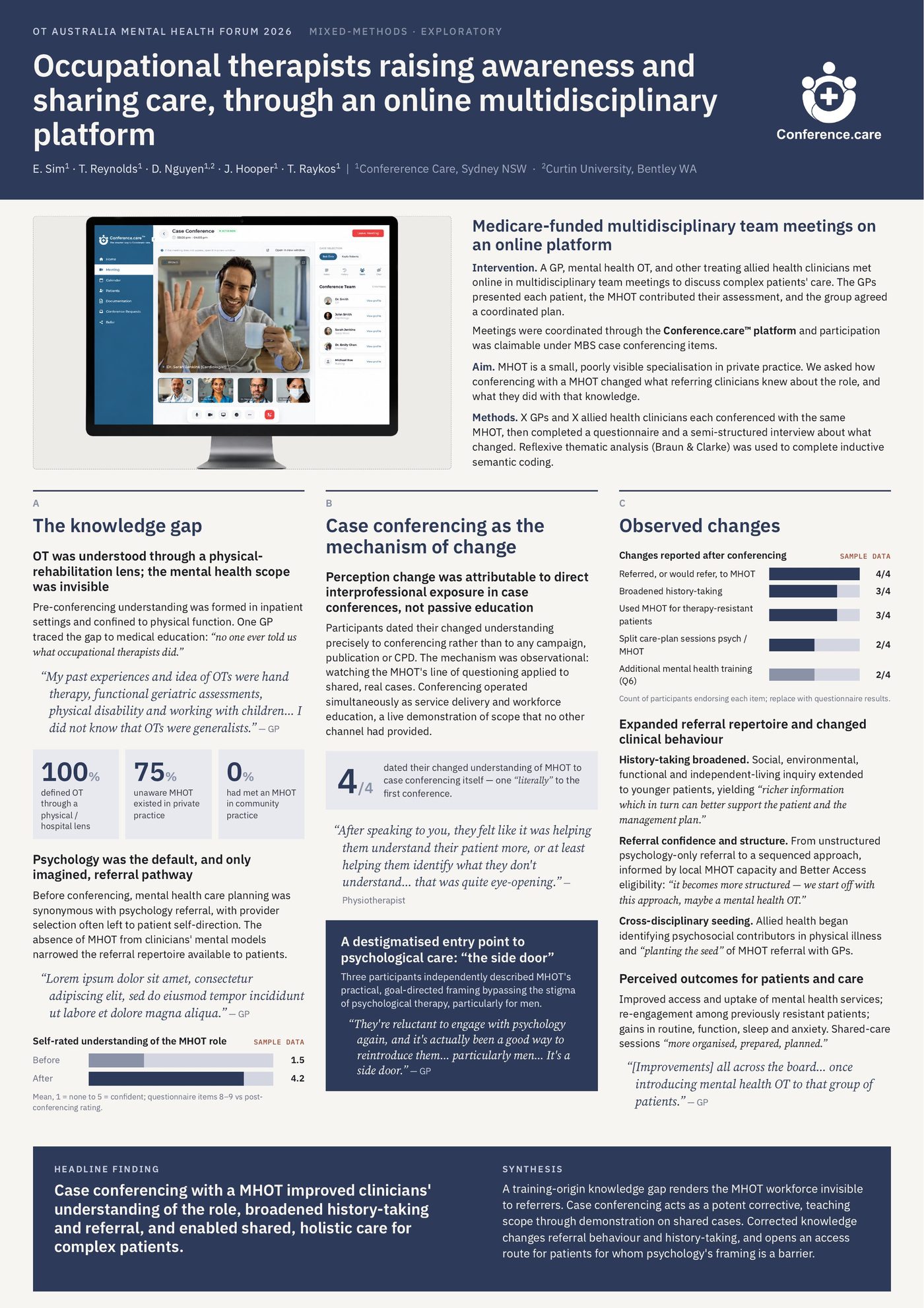
Conference poster: Occupational therapists raising awareness and sharing care, through an online multidisciplinary platform Draft — final poster to follow
Poster

Occupational therapists raising awareness and sharing care, through an online multidisciplinary platform

E. Sim, T. Reynolds, D. Nguyen, J. Hooper, T. Raykos

Conference.care, Sydney NSW · Curtin University, Bentley WA

Occupational Therapy Australia Mental Health Forum

October 2026

How conferencing with a mental health occupational therapist changed what GPs and allied health clinicians knew about the role — and what they did with that knowledge afterwards.


Abstract accepted

Mind the gap: Making shared care work between rural GPs, specialists, and allied health clinicians

T. Reynolds1, P. de Guzman2, D. Nguyen1,3, J. Hooper1

1 Conference.care, Sydney NSW · 2 Rural Clinical School, University of Western Australia · 3 Curtin University, Bentley WA

Compass Conference 2026 · Northern Territory PHN

14–15 August 2026 · Darwin Convention Centre, Darwin NT

Shared care across distance, broadened from mental health to chronic disease for the Territory's primary care audience — accepted for Compass NT 2026 under the theme 'Changing Territory: Sustainable, Smart and Responsive Primary Care'.

30-minute academic presentation

Closing the distance: A digital approach to rural multidisciplinary care

T. Reynolds1, P. de Guzman2, D. Nguyen1,3, J. Hooper1

1 Conference.care, Sydney NSW · 2 Rural Clinical School, University of Western Australia · 3 Curtin University, Bentley WA

Rural Medicine Australia 2026 · Hosted by ACRRM and RDAA

23 October 2026 · Adelaide Convention Centre, Tarndanya (Adelaide)

A 30-minute paper in the RMA26 academic program on what changes for a rural practice when the specialist and allied health team can be brought to the patient by video.

Presentation

Mind the gap: Making shared care work between rural GPs and mental health clinicians

T. Reynolds1, J. Gillbard1, D. Nguyen1,2, E. Sim1, J. Hooper1

1 Conference.care, Sydney NSW · 2 Curtin University, Bentley WA

Rural Mental Health Conference 2026 · Australian & New Zealand Mental Health Association

4–6 November 2026 · RACV Royal Pines Resort, Gold Coast QLD

Shared mental health care across rural distance: what a digital coordination platform changed for communication, treatment plans, role clarity and clinician burden across sites in Western Australia.

Our programme

What we're studying next

Six studies, from a randomised trial to interview research, at stages from design through to analysis.

Cost-effectiveness study

Cost-effectiveness of Medicare-funded GP case conferencing in chronic disease

An economic evaluation of MBS-funded GP case conferencing for chronic conditions: incremental cost per patient against usual care, downstream service utilisation, and the cost borne by the practice against the rebate it recovers.

Controlled study

Case conferencing after total knee arthroplasty

Case conferencing versus standard care for postoperative outcomes in total knee replacement, where surgeon, GP, physiotherapist and patient too often work from different plans.

Pilot study

Multidisciplinary conferencing for children in rural Australia

A pilot of case conferencing for developmental and neurodivergent children in rural and regional areas, where the paediatric and allied health team is rarely in the same town.

Who we work with

Research partners

In partnership with academics at

Curtin University Macquarie University UNSW Sydney The University of Western Australia

Take part

Practices and clinicians make this possible

Every study runs inside ordinary general practice. If your practice runs case conferences — or would like to — you can contribute to the evidence base without changing how you work. Researchers and institutions interested in collaborating are welcome too.

  • PracticesHost a study in your rooms, with recruitment and consent handled through the platform.
  • CliniciansTake part in interview and survey research on how team-based care works day to day.
  • ResearchersPartner on trial design, health economics or workforce research.

Who we are

Clinician-built, and checked by their peers

Conference.care is made by New Frontier Health — GPs, allied health clinicians and researchers building the tools they wanted in their own practices.

References

  1. King MA, Roberts MS. Multidisciplinary case conference reviews: improving outcomes for nursing home residents, carers and health professionals. Pharmacy World & Science. 2001;23(2):41–5. Available from: https://doi.org/10.1023/a:1011215008000
  2. Agar M, Luckett T, Luscombe G, Phillips J, Beattie E, Pond D, et al. Effects of facilitated family case conferencing for advanced dementia: a cluster randomised clinical trial. PLoS ONE. 2017;12(8):e0181020. Available from: https://doi.org/10.1371/journal.pone.0181020
  3. Shelby-James T, Currow D, Phillips P, Williams H, Abernethy A. Promoting patient centred palliative care through case conferencing. Australian Family Physician. 2007;36(11):961–3. Available from: https://www.racgp.org.au/afp/200711/20754
  4. Phillips JL, West PA, Davidson PM, Agar M. Does case conferencing for people with advanced dementia living in nursing homes improve care outcomes: evidence from an integrative review? International Journal of Nursing Studies. 2012;50(8):1122–35. Available from: https://doi.org/10.1016/j.ijnurstu.2012.11.001
  5. Shelby-James T, Butow P, Davison G, Currow D. Case conferences in palliative care: a substudy of a cluster randomised controlled trial. Australian Family Physician. 2012;41(8):608–12.
  6. Vest JR, Blackburn J, Yeager VA, Haut DP, Halverson PK. Primary care-based case conferences and reductions in health care utilization. Journal of Health Care for the Poor and Underserved. 2021;32(3):1288–1300. Available from: https://doi.org/10.1353/hpu.2021.0132
  7. Reuther S, Dichter MN, Büscher I, Vollmar HC, Holle D, Bartholomeyczik S, et al. Case conferences as interventions dealing with the challenging behavior of people with dementia in nursing homes: a systematic review. International Psychogeriatrics. 2012;24(12):1891–1903. Available from: https://doi.org/10.1017/s1041610212001342
  8. Mitchell G, Del Mar C, O'Rourke P, Clavarino A. Do case conferences between general practitioners and specialist palliative care services improve quality of life? A randomised controlled trial. Palliative Medicine. 2008;22(8):904–12. Available from: https://doi.org/10.1177/0269216308096721
  9. Hollingworth S, Zhang J, Vaikuntam BP, Jackson C, Mitchell G. Case conference primary-secondary care planning at end of life can reduce the cost of hospitalisations. BMC Palliative Care. 2016;15(1). Available from: https://doi.org/10.1186/s12904-016-0157-9
  10. Australian Bureau of Statistics. Patient Experiences in Australia, 2024–25 financial year. ABS, Canberra. abs.gov.au
  11. Australian Government Department of Health and Aged Care. Medicare Benefits Schedule — all 106 multidisciplinary case conferencing items, and explanatory notes AN.0.49 and MN.3.2. Item numbers, duration bands, schedule fees and benefits on this site are extracted directly from the machine-readable schedule (MBS-XML-20260801.XML, effective 1 August 2026); GP attendances out of hospital attract the 100% benefit, specialist and allied health attendances the 85% benefit. MBS Online downloads · item search
  12. Australian Bureau of Statistics. Aboriginal and Torres Strait Islander life expectancy, 2020–2022. ABS, Canberra. abs.gov.au
  13. Australian Institute of Health and Welfare. Australian Burden of Disease Study: impact and causes of illness and death in Aboriginal and Torres Strait Islander people 2018. AIHW, Canberra. aihw.gov.au
  14. Australian Government. National Agreement on Closing the Gap — targets and outcomes. closingthegap.gov.au
  15. Australian Institute of Health and Welfare. Rural and remote health. AIHW, Canberra. aihw.gov.au
  16. Australian Institute of Health and Welfare. Multimorbidity in Australia. AIHW analysis of the ABS 2022 National Health Survey; multimorbidity defined as 2 or more of 72 selected long-term health conditions. aihw.gov.au
  17. Bates SM, Lin J, Allen LN, Wright M, Kidd M. Can multidisciplinary teams improve the quality of primary care? A scoping review. eClinicalMedicine. 2025;88:103497. https://doi.org/10.1016/j.eclinm.2025.103497
  18. Australian Government Department of Health, Disability and Ageing. Upcoming Changes to Chronic Disease Management Framework — MBS Items for GP Chronic Condition Management Plans, factsheet, last updated 22 May 2025. Patients with a plan may access up to 5 individual allied health services per calendar year (10 for patients of Aboriginal or Torres Strait Islander descent). mbsonline.gov.au
  19. The Royal Australian College of General Practitioners. General Practice: Health of the Nation 2025. RACGP, East Melbourne, 2025. Executive summary and Chapter 2 (state of the general practice workforce). racgp.org.au/health-of-the-nation-2025; full report (PDF): Health-of-the-Nation-2025.pdf.
  20. Australian Bureau of Statistics. National Study of Mental Health and Wellbeing, 2020–2022. ABS, Canberra. 21.5% (4.3 million) of people aged 16–85 had a 12-month mental disorder. abs.gov.au
  21. Belcher J, Myton R, Yoo J, Boville C, Chidwick K. Exploring the physical health of patients with severe or long-term mental illness using routinely collected general practice data from MedicineInsight. Australian Journal of General Practice. 2021;50(12):944–9. Available from: doi.org/10.31128/AJGP-08-20-5563