

















For practice owners & managers

Connected care. Stronger practice.

Conference.care makes it easy for your clinicians to coordinate Medicare-funded case conferences — bringing in new revenue, deepening referral relationships and reducing admin, all from one secure platform.

Join practices across Australia · GP, specialist & allied health.

The Conference.care case-conferencing platform
100% freefor practices — no subscriptions, no fees, no lock-in.

Trusted by health practitioners across Australia

Lockridge Medical CentreSonic HealthPlusAsterix Medical CentreBroadway MedicalWongan Hills Medical CentreRanford Medical CentreCoolbellup Medical CentreNorthbridge Medical CentreNorth Perth Family GPBayswater GPCandlewood Medical CentreChampion Lakes Medical CentreFulham GPBroadway MedicalBentley Plaza Family PracticeMead Medical
Illustration of a patient holding their head, surrounded by a wait list, a broken Medicare card, a phone on hold, a bundle of cash and a clock
38%
of Australians — 9.7 million people — live with two or more long-term conditions, rising to 79% of those aged 85 and over

The unfortunate truth

The patients who most need multidisciplinary care rarely receive it.

A patient with several long-term conditions needs input from an entire multidisciplinary team.

In practice, they rarely get it. Costs are prohibitive, wait times are ludicrous, and limited Medicare funding covers just 5 allied health sessions a year under a care plan.

Consequently, their GPs are left managing their care largely alone, without meaningful multidisciplinary input.

The consequence

Complex patients weigh on the practice, and on the GPs who carry them

A patient with several long-term conditions takes long consults, coordination and follow-up that is never billed, and appointments that overrun.

GPs find these patients the hardest to carry. Growing complexity is now the challenge GPs name more often than any other, and most are dissatisfied with the time they spend on care Medicare does not fund.

  • 68%

    of GPs name the growing complexity of patient presentations as their most common challenge

  • nearly 7 in 10

    GPs report burnout

The solution

Case conferences provide funding and support to your GPs managing complex patients

Case conferences are multidisciplinary meetings where a GP sits down with specialists, allied, and mental health to agree on needs, goals and a treatment plan for complex patients.

These discussions are rebated by Medicare — so the coordination that was non-billable becomes a rebated session, with a team in it.

The patient doesn’t need to attend — it’s a clinician-to-clinician discussion; their GP relays the outcomes to them afterwards.
LIVEGP
Cardiologist
Physiotherapist
Psychologist
Conference controls

Why practices choose Conference.care

Better for your clinicians, your patients and your bottom line

For your clinicians

  • Enhanced clinical decision-making
  • Patient problems properly identified
  • More effective care plans

For your patients

  • Fewer hospitalisations and ED presentations
  • Better symptom management and quality of life
  • Lower overall healthcare costs

For your practice

  • Billings from patients already on the books
  • Referral relationships that come back
  • No consulting room tied up
  • Attract and retain clinicians

Two ways your GPs can use case conferencing

Get specialist input without the wait

Put the case to clinicians who aren’t treating your patient and get discipline-specific thinking on what’s driving the presentation.

Indicators

  • Complexity and comorbidity
  • Current management not achieving outcomes
  • Input outside scope

Coordinate the treating team

Referrals, letters, scripts and recalls each run one way at a time, and you are the only person who hears all of it. A case conference puts everyone already involved in the one conversation, so the plan is agreed once.

Indicators

  • Treatment planning
  • Strategies to improve patient engagement with treatment
  • Share the load and reduce burn-out
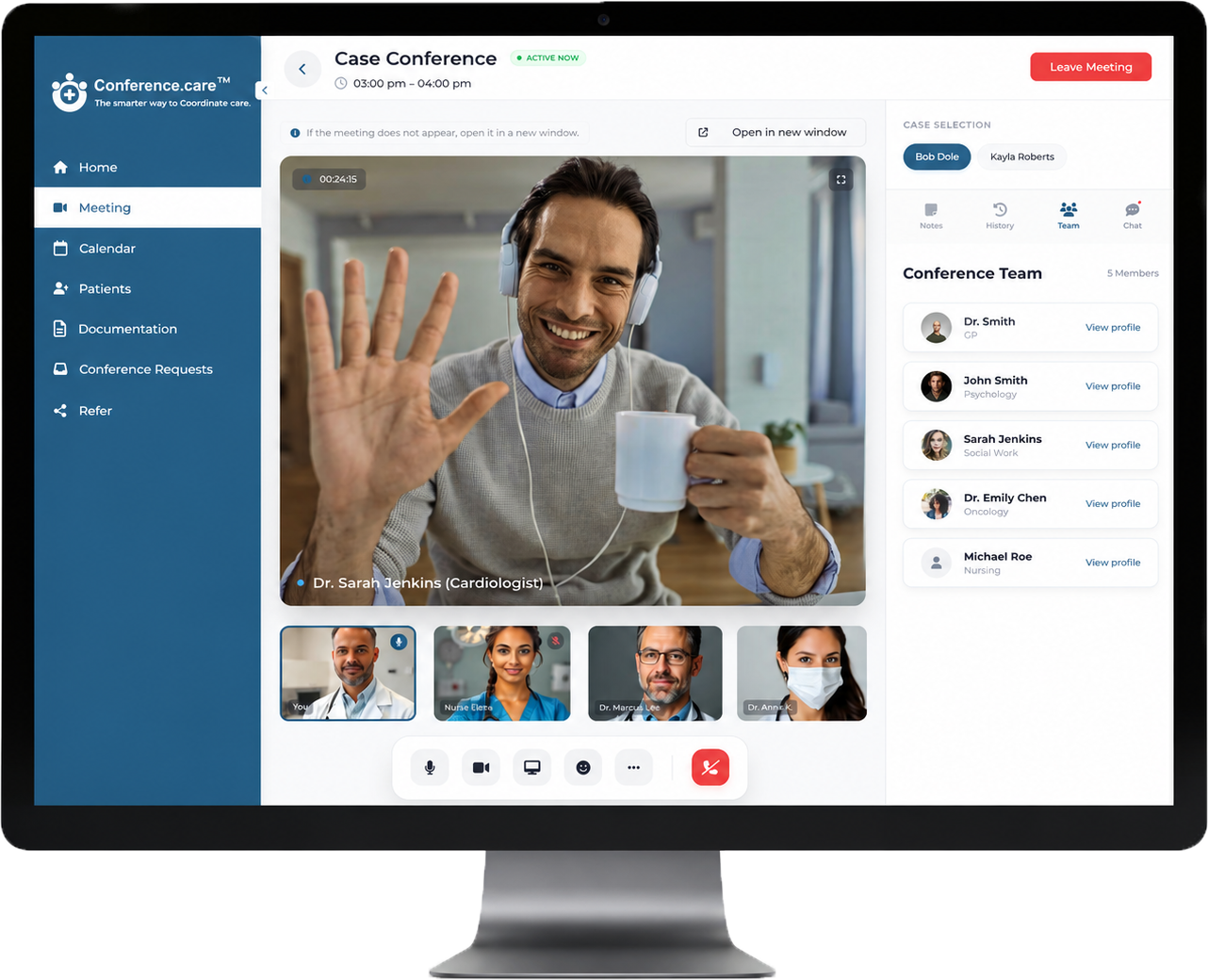
The Conference.care platform during a live case conference

Conference.care is a clinical team, and the platform built around it

Conference.care is a clinical service, not a piece of software you are left to run. We keep a credentialled team of local specialists and allied health clinicians with real-time availability, ready to join your GPs’ case conferences.

The platform is what makes that practical: it builds the team around each patient, finds a time, records consent, captures the notes during the call and prepares the documentation behind the claim.

1,346+
case conferences run on the platform
1,000+
participating specialists and allied health

How case conferences run through Conference.care

Your practice
SPDr S. Park
AMDr A. Mehta
JLDr J. Liu
Calendars synced
1

Add your GPs

Invite the GPs you want conferencing, and any specialists or allied health you already work with. Each gets their own login and calendar sync.

Your slot
Tue29
Case conference2:30 – 3:00 PM
Recurring weekly
2

Pick regular slots for your doctors

One-off, or the same time every week, set around each doctor’s diary. Everything else is built around that.

Add patient
PatientMargaret H. 78 · RACF
ConditionsType 2 diabetesHeart failureCKD
Eligible for a case conference
3

Add patients

Your GPs add the patients they want to discuss and the input they need.

Any patient with a chronic or complex condition is eligible.

Chronic painDiabetesFrailty & fallsCOPDObesity & metabolicSleep disordersCancerArthritisCardiovascular diseasePeripheral vascular diseaseUrinary incontinenceChronic kidney diseaseNeuropathyDementiaNeurological conditionsMedication complexityStroke recoveryMental health needs
Invitees don’t have to have seen your patient — their role can be purely advisory.
Choose from 1,000+ local clinicians
Yuliya RichardYuliya RichardPsychologist
Andrew IlieffAndrew IlieffPhysiotherapist
Michelle TheodosiMichelle TheodosiDietitian
Anthea KarseboomAnthea KarseboomOccupational therapist
Hayden FisherHayden FisherExercise physiologist
Marianne Del PapaMarianne Del PapaDiabetes educator
Anita FranklinAnita FranklinMental health social worker
David WalkleyDavid WalkleyChiropractor
Emma SnelgarEmma SnelgarMental health nurse
AndreaAndreaPodiatrist
David John EdwardsDavid John EdwardsPsychologist
Danielle ClintonDanielle ClintonPhysiotherapist
Invitations sent · regular GP included
4

We build your team

Your GP picks the disciplines the patient needs; we invite the best available clinicians from our 1,000+ local specialists and allied health. Nobody at the practice chases anyone.

All specialists, allied health, and GPs are eligible.

GeriatricianCardiologistEndocrinologistGastroenterologistNeurologistRespiratory & SleepRheumatologistNephrologistHaematologistOncologistImmunologist & AllergyInfectious DiseasesPalliative MedicinePain MedicineRehabilitationGeneral PhysicianPaediatricianPsychiatristPhysiotherapistOccupational TherapistSpeech PathologistSocial WorkerExercise PhysiologistDiabetes EducatorPodiatristMental Health NurseDietitianPsychologist
The Conference.care platform
5

Your GPs talk it through live, in one secure place

Each discussion is a short, secure video session inside Conference.care. Your doctors join from the consulting room or from home; the platform captures the notes and supports the claim.

Encrypted video Secure live notes Join from anywhere
Up to
$456.60
per hour — three 20-minute conferences, plus the bulk-billing incentive
6

Your GPs get rebated

Your GP claims an MBS item every time they coordinate a conference, and the specialists and allied health who join claim their own.

Figures are indicative and do not constitute financial or clinical advice. Conference duration, frequency and composition remain clinical decisions for the coordinating practitioner.

7

Claim CPD for every case conference

The same minutes that earn the item earn CPD, logged from the time actually spent in the room. Where it goes depends on the college.

We help you satisfy every Medicare requirement automatically

Team composition, duration tiers, frequency intervals and the right item number — the platform holds you to each of them as you schedule, run and document the conference, so a claim is never left to memory.

Every clause of the case-conferencing items, and how the platform meets it, is set out on one page.

  • Consent, before anything is booked. The patient is texted a plain-English explanation and asked to agree; their agreement is stored with the date and time.
  • Times and participants, captured automatically. Start and end times and every participant are recorded by the platform, not typed up afterwards.
  • One shared record. Everyone writes into a single document alongside the session; it goes to every participant and exports into the patient’s record.
  • Bulk billing in one message. After the conference the patient assigns their benefit by reply — nothing to print or sign.

How it works for your practice

Set up once. We manage the rest.

Add patients

Your GPs add the patients they want discussed; the team is built around each one.

Import documentation

Conference notes and referrals flow to admin for upload to the patient record.

Monitor performance

See conference activity and the revenue your practice is generating at a glance.

How much can your clinicians make?

Generously rebated by Medicare

Case conferences are rebated across GP, specialist and allied health item numbers — at rates well above standard consults. Estimate the upside for your practice with our revenue & local-health-need tool.

Practice revenue estimator

Enter your location, clinician count and service fee to see what case conferencing could generate for your practice — alongside the chronic-disease needs most elevated in your area.

Open the estimator

Case conferencing vs standard billings

Standard consults, bulk billed
$210
Case conferencing
up to $457 / hr

4 × GP Level B consults (item 23), bulk billed in MM1, against three 20-minute conferences in the hour. Figures are indicative and do not constitute financial or clinical advice.

Everything around the conference, handled

Whether you organise the conference or join one, Conference.care clears the coordination, compliance and paperwork — so your time goes to the clinical discussion.

Standard case conferencingThrough Conference.care
Phone tag to coordinate schedulesA team rostered to suit the patient, times confirmed
Complex MBS compliance requirementsPrompts the correct item number and flags issues
Chasing everyone for their notes afterwards, then piecing them into one coherent set for the patient recordTeam notes written during the conference, automatically collated and provided for the patient file afterwards
Separate referrals to involve the patientSMS consent and a patient summary that keeps them informed
Travel, rooms, no-showsSecure online conferences from anywhere

100% free for practices. No lock-in. Always.

Conference.care is completely free for practices — no subscription and no per-conference charge. Your clinicians claim the Medicare rebates; we never take a cut.

Who’s behind it

Supported by a GP-led team

Conference.care was founded and is led by Australian GPs.

Dr Daniel Nguyen

Dr Daniel Nguyen

Co-founder · FRACGP

Dr Chris Mitchell AM

Dr Chris Mitchell AM

Former RACGP federal president

Dr Bruce Willett

Dr Bruce Willett

Former RACGP federal vice president

Not set up for telehealth? We’ll get you up and running.

For practices not already set up for telehealth, we help your clinicians get going — the equipment they need, the setup, and a run-through before their first conference.

A clinician using a tablet at a desk

Compliance & security

Built to meet Australian privacy and security standards

Developed in consultation with Avant Law, the legal arm of Australia's largest medical defence organisation, so compliance is handled as a forethought, not an afterthought.

Aligned to the Australian Privacy Act

  • Built to the Australian Privacy Principles
  • Strict role-based access controls
  • Minimal data retention

Healthcare-grade security and infrastructure

  • Data encrypted in transit and at rest
  • Data hosted onshore, in Australia
  • Regular security audits and testing

Guides & documents

Short, practical references for your practice.

GP flyer

Medicare-funded case conferencing for GPs — eligibility, rebates and how it works, on one page.

Download

Patient flyer

A5 take-away for the patient — what a case conference is, who takes part and what it means for their care.

Download

Practice brochure

The practice-level view: what case conferencing changes for your practice and how to get started.

Download

Questions

Practice frequently asked questions

Is Conference.care free for our practice?

Yes — completely free, with no subscription and no per-conference charge. Your clinicians claim the Medicare rebates as usual; we never take a cut.

How does case conferencing generate revenue for us?

Case conferences are rebated by Medicare, across GP, specialist and allied health item numbers. It is a funded activity your clinicians can offer complex patients — not a reclassification of work they already do.

Does it integrate with our practice software?

Yes. Conference.care integrates with the major Australian PMS, including Best Practice, MedicalDirector and Genie, so records and referrals flow between your systems and the conference team.

What does our admin team need to do?

Very little. Documentation, consent capture and referrals are routed to admin ready for upload — the coordination and compliance prompts are built into the platform. For a detailed walkthrough, see the Practice Admin Guide.

Can we oversee all our clinicians' conferences?

Yes. Practice staff can view, manage and report on upcoming and past conferences across all your clinicians from one place.

Do our clinicians need any special equipment?

No — Conference.care runs in any web browser. For practices not already set up for telehealth, we'll help get you up and running.

Any other questions? Ask in the chat at the bottom for an immediate answer. Our clinician-led team will pick up anything requiring their specialist advice.

Revenue estimator

See your practice's upside

Model the case-conferencing revenue your practice could generate — and see the local burden of chronic disease your patients carry.

Open the calculator

Bring case conferencing to your practice

Completely free for practices. Help your clinicians deliver better-coordinated care — and get paid for the time they already spend.

References

  1. King MA, Roberts MS. Multidisciplinary case conference reviews: improving outcomes for nursing home residents, carers and health professionals. Pharmacy World & Science. 2001;23(2):41–5. Available from: https://doi.org/10.1023/a:1011215008000
  2. Agar M, Luckett T, Luscombe G, Phillips J, Beattie E, Pond D, et al. Effects of facilitated family case conferencing for advanced dementia: a cluster randomised clinical trial. PLoS ONE. 2017;12(8):e0181020. Available from: https://doi.org/10.1371/journal.pone.0181020
  3. Shelby-James T, Currow D, Phillips P, Williams H, Abernethy A. Promoting patient centred palliative care through case conferencing. Australian Family Physician. 2007;36(11):961–3. Available from: https://www.racgp.org.au/afp/200711/20754
  4. Phillips JL, West PA, Davidson PM, Agar M. Does case conferencing for people with advanced dementia living in nursing homes improve care outcomes: evidence from an integrative review? International Journal of Nursing Studies. 2012;50(8):1122–35. Available from: https://doi.org/10.1016/j.ijnurstu.2012.11.001
  5. Shelby-James T, Butow P, Davison G, Currow D. Case conferences in palliative care: a substudy of a cluster randomised controlled trial. Australian Family Physician. 2012;41(8):608–12.
  6. Vest JR, Blackburn J, Yeager VA, Haut DP, Halverson PK. Primary care-based case conferences and reductions in health care utilization. Journal of Health Care for the Poor and Underserved. 2021;32(3):1288–1300. Available from: https://doi.org/10.1353/hpu.2021.0132
  7. Reuther S, Dichter MN, Büscher I, Vollmar HC, Holle D, Bartholomeyczik S, et al. Case conferences as interventions dealing with the challenging behavior of people with dementia in nursing homes: a systematic review. International Psychogeriatrics. 2012;24(12):1891–1903. Available from: https://doi.org/10.1017/s1041610212001342
  8. Mitchell G, Del Mar C, O'Rourke P, Clavarino A. Do case conferences between general practitioners and specialist palliative care services improve quality of life? A randomised controlled trial. Palliative Medicine. 2008;22(8):904–12. Available from: https://doi.org/10.1177/0269216308096721
  9. Hollingworth S, Zhang J, Vaikuntam BP, Jackson C, Mitchell G. Case conference primary-secondary care planning at end of life can reduce the cost of hospitalisations. BMC Palliative Care. 2016;15(1). Available from: https://doi.org/10.1186/s12904-016-0157-9
  10. Australian Bureau of Statistics. Patient Experiences in Australia, 2024–25 financial year. ABS, Canberra. abs.gov.au
  11. Australian Government Department of Health and Aged Care. Medicare Benefits Schedule — all 106 multidisciplinary case conferencing items, and explanatory notes AN.0.49 and MN.3.2. Item numbers, duration bands, schedule fees and benefits on this site are extracted directly from the machine-readable schedule (MBS-XML-20260801.XML, effective 1 August 2026); GP attendances out of hospital attract the 100% benefit, specialist and allied health attendances the 85% benefit. MBS Online downloads · item search
  12. Australian Bureau of Statistics. Aboriginal and Torres Strait Islander life expectancy, 2020–2022. ABS, Canberra. abs.gov.au
  13. Australian Institute of Health and Welfare. Australian Burden of Disease Study: impact and causes of illness and death in Aboriginal and Torres Strait Islander people 2018. AIHW, Canberra. aihw.gov.au
  14. Australian Government. National Agreement on Closing the Gap — targets and outcomes. closingthegap.gov.au
  15. Australian Institute of Health and Welfare. Rural and remote health. AIHW, Canberra. aihw.gov.au
  16. Australian Institute of Health and Welfare. Multimorbidity in Australia. AIHW analysis of the ABS 2022 National Health Survey; multimorbidity defined as 2 or more of 72 selected long-term health conditions. aihw.gov.au
  17. Bates SM, Lin J, Allen LN, Wright M, Kidd M. Can multidisciplinary teams improve the quality of primary care? A scoping review. eClinicalMedicine. 2025;88:103497. https://doi.org/10.1016/j.eclinm.2025.103497
  18. Australian Government Department of Health, Disability and Ageing. Upcoming Changes to Chronic Disease Management Framework — MBS Items for GP Chronic Condition Management Plans, factsheet, last updated 22 May 2025. Patients with a plan may access up to 5 individual allied health services per calendar year (10 for patients of Aboriginal or Torres Strait Islander descent). mbsonline.gov.au
  19. The Royal Australian College of General Practitioners. General Practice: Health of the Nation 2025. RACGP, East Melbourne, 2025. Executive summary and Chapter 2 (state of the general practice workforce). racgp.org.au/health-of-the-nation-2025; full report (PDF): Health-of-the-Nation-2025.pdf.
  20. Australian Bureau of Statistics. National Study of Mental Health and Wellbeing, 2020–2022. ABS, Canberra. 21.5% (4.3 million) of people aged 16–85 had a 12-month mental disorder. abs.gov.au
  21. Belcher J, Myton R, Yoo J, Boville C, Chidwick K. Exploring the physical health of patients with severe or long-term mental illness using routinely collected general practice data from MedicineInsight. Australian Journal of General Practice. 2021;50(12):944–9. Available from: doi.org/10.31128/AJGP-08-20-5563