








































A GP flags a complex patient to discuss
A GP tags a complex patient on their own clinical system — the clinical call stays with them.

For allied & mental health clinicians
Conference.care places you into Medicare-funded case conferences alongside other healthcare professionals. You advise the patient’s doctor directly, expand your network and benefit from the referrals that follow.
Work remotely, during the hours that suit you best.
Sign up for free · Join only the conferences that suit you.
Trusted by health practitioners across Australia


The unfortunate truth
A patient with several long-term conditions needs input from an entire multidisciplinary team.
In practice, they rarely get it. Costs are prohibitive, wait times are ludicrous, and limited Medicare funding covers just 5 allied health sessions a year under a care plan.
Consequently, their GPs are left managing their care largely alone, without meaningful multidisciplinary input.
A case conference is a multidisciplinary meeting to discuss the care needs of patients with complex or chronic conditions. The GP presents the case. The allied health team advise. The GP decides what happens next.
Unlike standard correspondence, case conferencing enables real-time dialogue — shared decision-making and cohesive treatment, without requiring the patient to attend or be referred externally.
You don’t need to be treating the patient. The MBS Online note is explicit: “the health professional is not required to have a pre-existing relationship with the patient”.
Why it’s different
Unlike referral letters or phone calls, case conferencing lets a care team consider a patient synchronously together — and be rebated for it.
| Capability | Case conferencing | Referral letters | Phone calls |
|---|---|---|---|
| Real-time, synchronous discussion | ✓ | Delayed | ✓ |
| Group consideration of the patient | ✓ | — | — |
| Specialist input without a separate referral | ✓ | — | — |
| Time spent is billable | ✓ | — | — |
| Efficient, instant feedback | ✓ | Delays | Phone tag |
Research consistently shows multidisciplinary case conferences deliver wide-ranging benefits across many health contexts.
Conference.care is a clinical service, not a piece of software you are left to run. We keep a credentialled team of local specialists and allied health clinicians with real-time availability — the team you would be joining — convened around GPs’ most complex patients.
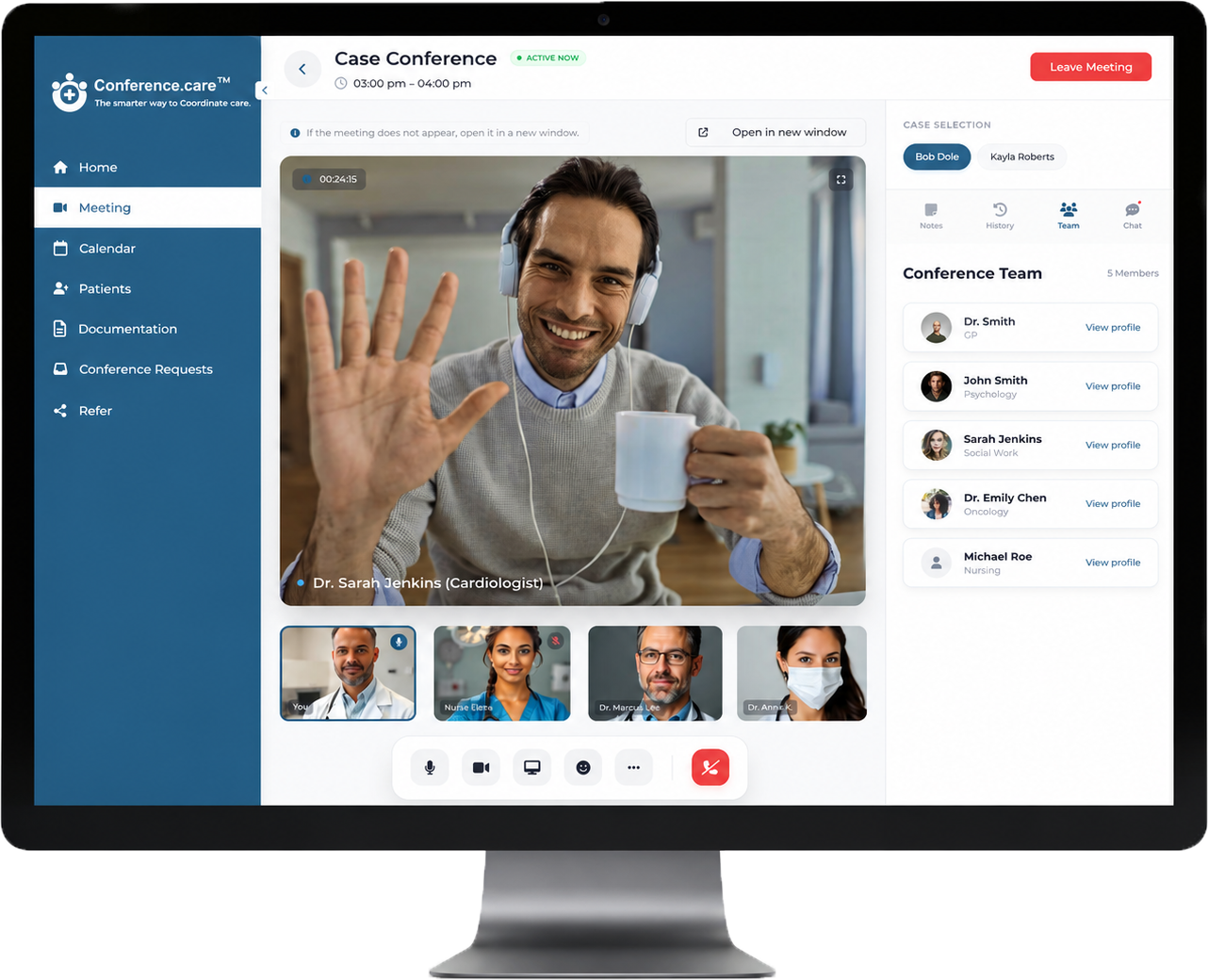
The platform is what makes that practical: it builds the team around each patient, finds a time, records consent, captures the notes during the call and prepares the documentation behind the claim.
How it works
A GP tags a complex patient on their own clinical system — the clinical call stays with them.

A GP asks you in for your expertise. One tap accepts — the platform handles the time, the secure video link and the paperwork.
Each discussion is a short, secure video session inside Conference.care — you join, give your advice on the call, and the platform captures the notes and supports the Medicare claim.
Move the slider to see indicative earnings at a typical participation rate.
Modelled at $128 an hour of participation, over 46 working weeks — three 20-minute participations in an hour, typical of what a clinician receives once our service fee has been taken off. Figures are indicative and do not constitute financial or clinical advice. Conference duration, frequency and composition remain clinical decisions for the coordinating practitioner.
Participation is covered by its own MBS items, tiered by how long the conference runs. There is no paperwork at your end and nothing to lodge — once Medicare has paid, we pay you for your time.
No prep, no travel, no rooms to pay for and no write-up afterwards: simply record your notes during the conference and you are done. A clinical hour in private practice usually sits inside a much longer unpaid one — here, the time you spend is the time you are paid for.
This certifies that J. Liu, Dietitian took part in a
Multidisciplinary case conference
Every allied-health body asks the same two things of a CPD activity: that it is relevant to your practice, and that you record what you learned. A case conference about your own patient is both.
When a GP works a case through with you, they see your standard first-hand — and refer while the case is still front of mind, in one click from the portal.
What it involves
The commitment is the conference itself and nothing around it. Here is the whole of it, before you decide.
Conferences run whenever the coordinating GP or specialist schedules them, including weekends and after hours. Practices often settle into a regular weekly timeslot, so you take the ones that fit around your existing book.
There are three time tiers. Which one a conference falls in follows the patient’s presentation and the convening practitioner’s judgement — and you know which applies before you accept.
Take the conferences that suit your week and decline the rest. No unrealistic expectations, no pressure — how much you take on is entirely up to you.
Entirely on our secure platform, from wherever you are in Australia. Both you and the patient need to be physically in Australia for the item to be claimable.
The GP presents the patient and you give your view from your own expertise. What happens next is their call — you are advising the GP, not taking the patient on.
And nothing afterwards either. No prep, no travel, no rooms to pay for and no write-up at the end — you record your notes during the conference itself. The time you spend is the time you are paid for.
Who we’re looking for
If you’re an allied or mental health professional with current AHPRA or professional registration, apply to join us today.
Every clinician on a Conference.care conference has been screened and approved before they get there. So when a GP works a case through with you, they are seeing that standard first-hand — and that is what gives them the confidence to refer afterwards.
Your location, your wait times, whether you do telehealth and what you charge — so the question of whether you can take the patient is answered before it’s asked.
It happens while the case is still front of mind — not a letter that has to be written later, or never gets written at all.
You’re assigned to conferences with practices in your area — so when a GP decides to refer, their patient can actually get to you.
Take a practice’s conferences regularly and you become the clinician they think of first in your discipline — because they have worked with you, repeatedly, on their own patients.
The portal walks you through it — registration, insurance, provider number, disciplines and the agreements, in one form.
A real person reads every application. Matching is deliberately local — so when a GP refers afterwards, their patient can actually reach you.
Each one shows the patient’s presenting problems, the time and who else is on the team. Take the ones that suit your schedule.
Joining costs nothing, and you only take the conferences that suit you.
Who’s behind it
Conference.care is run by allied health clinicians. You get direct access to that team for help with the clinical, administrative and Medicare-compliance side of case conferencing — whenever you need it.
Physiotherapy lead
Dietetics lead
Psychology lead
Occupational therapy lead
Nursing lead
Exercise physiology lead
Compliance & security
Developed in consultation with Avant Law, the legal arm of Australia’s largest medical defence organisation, so compliance is handled as a forethought, not an afterthought.
Allied health questions
Yes. The MBS explanatory note for these items says it directly: “The health professional is not required to have a pre-existing relationship with the patient.” A referral isn’t required either. Where the patient does already have a treating clinician in your discipline, that clinician is invited first.
That’s the GP’s decision — and working a case through with you helps them see the benefit your expertise brings to the patient’s care. From there we remove the friction: your wait times, fees and availability are on screen while they’re deciding, referring is a single click from the conference record, and conferences are matched locally so the patient can reach you.
The GP presents the patient and you give your view from your own expertise. What happens next is their call — you are advising the GP, not taking the patient on. If they decide to refer afterwards, that is a separate decision they make in their own time.
The GP, plus the disciplines clinically indicated for that patient. Where the patient already has a treating clinician in a discipline, that clinician is invited first. Take a practice’s conferences regularly and they become familiar faces.
It depends on the patient and what the GP needs to work through — duration is a clinical decision for the coordinating practitioner. The MBS has three time tiers for participation, and you will know which one applies before you accept.
Entirely on the secure platform, from wherever you are — no travel, no rooms to book. You can take conferences anywhere in Australia, though both you and the patient need to be onshore.
No — conferences run whenever the coordinating GP or specialist schedules them, including weekends and after hours. Practices often settle into a regular weekly timeslot, so you can take the ones that fit around your existing book.
Participation in a case conference is covered by its own MBS items, tiered by how long the conference runs. You don’t lodge anything and there is no paperwork at your end: the claim is made through a location-based provider number set up for Conference.care conferences. Once Medicare has paid, we pay you for your time.
A service fee is retained from the participation item, the same arrangement a clinic has with the practitioners who work in it. You are paid the balance for your time once Medicare has paid out. There is nothing to pay if you take no conferences, and it is the only fee — no subscription, no joining cost.
No — and nothing afterwards either. You show up, you conference, you’re done. No prep, no travel, no rooms to pay for, and no write-up at the end: you record your notes during the conference itself. A clinical hour in private practice usually sits inside a much longer unpaid one. Here, the time you spend is the time you are paid for.
No. You accept only the conferences that fit your schedule, and there’s no minimum.
Update it at any time in the portal and offers follow the new availability automatically.
Conferences are matched by distance. Each team is built from the clinicians closest to the convening GP, so the sessions you are invited to are with practices in your area — which also means that if a GP refers afterwards, their patient can reach you.
The network reaches every state and territory and is still expanding, so how often conferences come up near you grows with it. If your area is quiet at first, that is the part that changes.
Yes — an additional one, linked to the Conference.care location. Medicare ties a provider number to a location, and conferences are bulk-billed at ours rather than at your practice, so the extra number is what lets the claim be made correctly. Your existing number is untouched and your own practice billing carries on exactly as it does now.
You can set it up yourself through PRODA, or sign the pre-filled form and we lodge it with Services Australia for you. Both routes are built into the sign-up, and the site ID and address you need are supplied as you go — you won’t have to source them.
Your basic details, your practice address, your registration number, your professional indemnity certificate and your availability — plus business and bank details, because we handle the billing and pay you directly.
The address matters more than it looks: invitations are matched on it, so it determines which conferences you hear about. Qualifications and areas of focus are optional, and worth adding — they give GPs a fuller picture of what you bring when they are deciding who to involve or who to refer to.
Yes. Allied health and mental health clinicians take part as contractors and are paid through Conference.care, so an ABN is part of the sign-up. Specialists bill Medicare directly and are not asked for one.
Usually within a day of finishing sign-up, provided your documents and details line up. If something needs adjusting our team comes back to you with a change request saying what to fix. If you haven’t heard within a week, get in touch with support.
No. Conference.care runs in any web browser, on any laptop, desktop or phone. All you need is an internet connection and a camera.
Any other questions? Ask in the chat at the bottom for an immediate answer. Our clinician-led team will pick up anything requiring their specialist advice.
Complex patients are managed better when the right disciplines actually talk to each other. Bring your expertise to the table, and take the conferences that suit you.